
The Best Places to Practice Speech Therapy Strategies
Practice Language Strategies Like a Speech Therapist
First, It’s important to learn what these tools are and how to best use them. In our Language Strategies at Home and What Words to Teach Early Communicators posts, we explain both steps and provide an overview of how you can support language skills.
These language learning strategies are powerful tools. You can use them to support your child’s language growth at home and in the community, such as at the park and the grocery store.
To use these strategies effectively, it is important to ‘think like a therapist. To do this, begin looking at every interaction in your child’s day as rich with potential learning opportunities. These opportunities are everywhere. Always look for ways to teach. Some of the best opportunities happen spontaneously!
Whenever your child interacts with you or others or needs to use language to accomplish something, there is a great opportunity for learning and language practice. For example, if you are in the kitchen and your child says ‘egg’ when he or she sees you making breakfast, you can expand on that by saying “Yes, I am going to break the egg over the pan.” Then you might also say, “I am taking another egg out of the refrigerator.”
Why Practice Speech Therapy Strategies at Home?
If your child works with a licensed speech-language pathologist, then you can easily complement that therapy when at home. Many children have difficulties with language use and need intensive speech and language therapy in addition to meaningful language support throughout at home. There are so many ways to provide that support all across settings.
Where Can I Practice These Strategies?
Begin by looking at your child’s day and his daily activities. In this post, we talk about many different places where you can support his or her skills. With just a few minutes of brainstorming, you will probably find many more places to support skill growth just by thinking about a typical day at home.
Speech Therapy Language Strategies in the Home
The Kitchen
One of the best places you can practice speech therapist based language learning is in your own kitchen! Remember that you are always looking for learning opportunities. You may find these where you are or they may happen in conversation, too.
When you’re in your kitchen, think about functions, needs and activities. What might you or your child do in the kitchen? There are many functions that can be supplemented with language. For example, your child may request items in the kitchen. What a perfect time to add new words to the ones he is already using.
For instance, your child may say, “ice cream,” or even just, “ice” to request a scoop of ice cream. In response, you may support his request by expanding on his words: “Oh, you want ice cream” or “You’re telling me that you want ice cream.” Then, when you bring out the ice cream, you can narrate your own actions. You might say, “I am bringing out the cold, strawberry ice cream! I’m putting it on the table.”
Of course, you won’t use these language strategies all of the time, and you shouldn’t feel bad when a teaching opportunity passes you by. You should aim to use them as often and regularly as possible, though. That way, your child is learning and practicing their language abilities as much as they can.
Consider all of the many activities that can happen in the kitchen. Setting a timer, peeling potatoes, turning the sink faucet on and off, washing veggies. Because kitchen activities relate to food (sometimes in very messy ways!), you can make them especially fun and reward for kids. Make sure that during all of this practice and home support, you don’t ask too many questions. You can use all of these types of language strategies to build your child’s expressive skills by providing rich narratives instead.
What can speech therapy language practice look like at home?
There are lots of examples of activities and interactions that can be used to support language growth. Remember that the language learning potential of any activity is only as good as the language you use to support them.
- Baking a cake together
- Picking which food to eat
- Organizing food on a plate
- Setting up the table
- Playing with food
- Mixing cake batter
- Making cereal
Another great tool is a play kitchen which can be a wonderful resource for families. They can be used for engaging in play and supporting language development. Just as you would in a real kitchen, practice pretending and talking about what you and your child are doing together. Emphasize the types of words below to encourage your child to talk about a variety of things.
What words and phrases are important in language therapy?
While there are many important words and phrases used in language therapy by a speech therapist, here are some of the types of words you should focus on.
- Prepositions (on, under, next to)
- Pronouns (he, she, theirs)
- Verbs (cut, wash, turn, want)
- WH words (who, what, where, when why)
- Adjectives (especially opposites)
Best Places to Practice Language Strategies
A Living Room
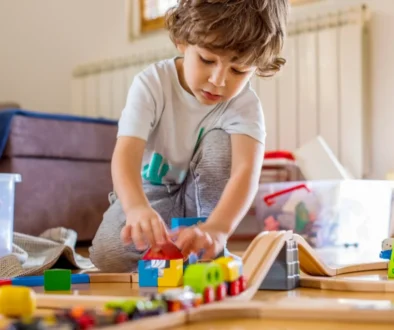
Now that you are feeling more prepared and are looking for those opportunities, start thinking of the living room. This is usually a communal space for families to engage and have fun. If this is where most of your child’s toys are, then that is a great place to begin.
Engage in pretend play using your child’s toys. Let your child direct the play. If your child chooses blocks to play with, then you also play with the blocks. He is spinning around with a stuffed animal, you find something else soft to spin around with.
Even when your child plays in a ‘non-traditional’ way, you can use his activity as motivation for language use. Follow his lead and use the teaching strategies to support skill growth. This is a proactive approach to learning which can have a large impact over time.
Look around and take what you see and think of how you might use it. Are you watching a movie? Perfect! Occasionally, pause the film and talk about what has happened so far. Pay attention to your own grammar and the words you use. Are you playing a game where players take turns? Point to others and talk about whose turn it is. Turn it into part of the game! When it is your turn you can say it to show your child what it sounds like when a person gets a turn. Talk aloud about what you are thinking, what you see happening and what you hope will happen next.
Remember that even though it’s not always easily seen, your language is being received and having a beneficial influence.
A Backyard (Or The Park)
If you have a backyard, then consider what you and your child usually do there. What do activities look like? How can you support language there? If there is a swing, you can practice verbs like ‘go,’ ‘push’ and ‘fall’. If there are trees, birds or houses around, you might practice talking about what you see. For example, you might say, “I see a big green tree” or “I see a brown dog with spots.” It can be helpful to focus on a small number of ‘sentence starters’ like “I see ______” and “Now let’s ______,” These help your child get used to these sentence structures and can help them anticipate new words that you put into them.
Always work to be aware of how you use language, the words you use and what you choose to emphasize. If you don’t have a yard but live near a park, that is a perfect alternative. If the park has play activities, such as a sandbox or swing, consider the verbs you might use, that you need to use to participate or continue some games.
Here we list some of the key verbs that go with each of these outdoor activities. Always think about how you can use speech therapy language strategies to make these activities language-rich.
- Swing sets – go, push, fall, kick, sit, jump
- Slides – climb, wait, sit, go, fall, stand
- House playset – open, close, fix, cook, sleep, touch
- Sandbox – push, scoop, touch, squeeze, dig, fill
- Water fountain – push, sip, splash, wash, go, dry
A Bedroom
Practicing speech therapist language tools can be used across your home throughout the day. And that includes your child’s bedroom. This is an excellent place to practice skills, especially since this is often a place that may already be a regular part of your child’s day. A bedroom can be a place for sleep, but it can also be a place to play with toys or games, read books, and draw or talk.
Storybook reading is an excellent opportunity to use these speech therapy strategies. Think about those important words (i.e., prepositions, verbs, pronouns, adjectives) and emphasize them during readings.
Share pictures and talk about what the characters do. Pay special attention to objects that depict prepositions, such as tables, a toy bin and the bed. You might also add to the story by giving your own special descriptions of events with a focus on the grammar and phrases you use.
When it is time to sleep you can talk about tucking in the sheets, your child going under the blankets or turning off the light. Think about important verbs that only have the chance to be used at certain times. Make a talking routine for nightly activities. This will help your child know what to expect and builds familiarity with talking about a specific nightly topic, such as having a bedtime snack, brushing teeth or reading a bedtime story.
Home Practice and Speech Therapy
Practicing these strategies at home can be a powerful way to support your child’s skill growth. However, home practice is not a replacement for quality, professional speech and language therapy. These tools complement children’s therapy but do not substitute it.
If your child shows trouble putting words together, finds understanding what you say challenging or has other difficulties, schedule a speech and language assessment with a licensed speech-language pathologist.
It is important to never wait for speech therapy, as skills build on each other and it is much harder to develop these skills later on.
How Do I Get Started with Speech Therapy Strategies at Home?
If you are wondering how to get started using these strategies, think about where you live and what activities look like. You can also read our other articles to learn more about providing support at home. If you are considering contacting a licensed speech therapist and are a California, Massachusetts, or Pennsylvania resident, please feel free to reach out to us here for a free consultation.